California NEM 3.0 Solar & Battery Payback Calculator (2026 Guide)
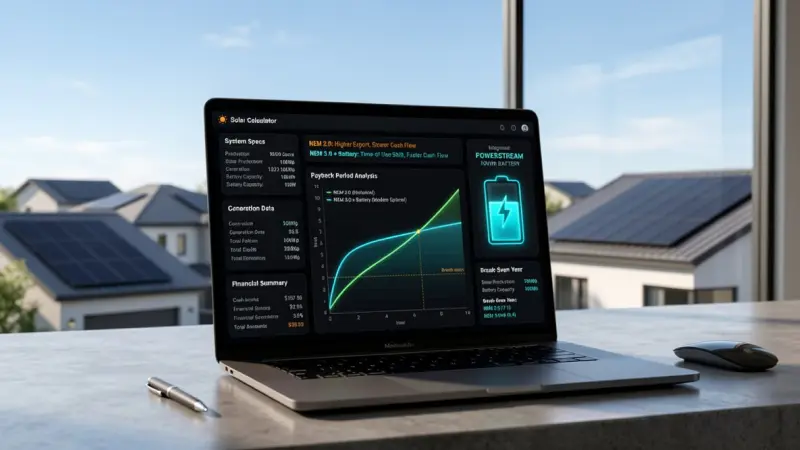
California's rooftop solar landscape underwent a fundamental transformation with the transition to the Net Billing Tariff (NEM 3.0) enacted by the California Public Utilities Commission (CPUC). For homeowners serviced by Pacific Gas & Electric (PG&E), Southern California Edison (SCE), and San Diego Gas & Electric (SDG&E), the era of full retail-rate net metering has ended.
Under NEM 3.0, grid export compensation dropped by approximately 75%. Solar-only installations that once paid for themselves in 4 to 5 years now face extended payback horizons. However, adding paired energy storage (lithium-ion / LFP batteries) fundamentally shifts the economics. By storing excess mid-day solar generation and discharging during peak evening demand windows, California homeowners can achieve 70% to 90% power bill offsets.
To calculate your custom ROI, system sizing, and battery dispatch parameters, run your energy profile through our interactive Solar Calculator in Los Angeles.
NEM 2.0 vs. NEM 3.0: The Financial Shift Explained
Under legacy NEM 2.0 rules, excess kilowatt-hours (kWh) exported to the utility grid were credited at full retail electricity rates ($0.30 - $0.42/kWh). Under NEM 3.0 (Solar Billing Plan), grid export credits are determined by the Avoided Cost Calculator (ACC), which dynamically varies compensation based on 576 hourly annual profiles.
Key Policy Differences
- Grid Export Value: Reduced from retail parity down to an average of $0.05 - $0.08 per kWh during standard hours. NBCs cannot be offset by solar export credits.
- Evening Peak Surge: During late summer evenings (August-September, 6 PM - 9 PM), ACC export adders spike significantly, rewarding battery owners who dump stored power back onto the grid at up to $2.00 - $3.00+ per kWh.
- Step 1 (Mid-Day): Solar Array generates power -> Charges Onsite Home Battery (Avoids Low $0.05 Export Credit).
- Step 2 (Peak Evening): Battery Discharges Stored Energy -> Powers Household Loads / EV Charger.
- Step 3 (Grid Protection): Eliminates Buying Peak Grid Power ($0.50+/kWh) -> Maximizes Utility Offset.
Calculating Payback Periods in California (2026 Data)
Is solar still worth it in California in 2026? Yes—if paired with battery storage. The table below breaks down real-world financial performance across PG&E, SCE, and SDG&E territories for a standard 7.2 kW PV array paired with a 13.5 kWh smart battery system:
| System Setup & Financial Parameter | Solar Only (NEM 3.0) | Solar + Battery Storage (NEM 3.0) |
|---|---|---|
| System Setup & Financial ParameterAverage Installed System Sizing | Solar Only (NEM 3.0)7.2 kW DC | Solar + Battery Storage (NEM 3.0)7.2 kW DC + 13.5 kWh LFP Battery |
| System Setup & Financial ParameterGross Equipment & Labor Cost | Solar Only (NEM 3.0)$22,600 | Solar + Battery Storage (NEM 3.0)$36,200 |
| System Setup & Financial Parameter30% Federal Clean Energy Credit (ITC) | Solar Only (NEM 3.0)-$6,780 | Solar + Battery Storage (NEM 3.0)-$10,860 |
| System Setup & Financial ParameterCalifornia SGIP Battery Rebate (Naye General Market Tier) | Solar Only (NEM 3.0)$0 | Solar + Battery Storage (NEM 3.0)-$1,350 to -$1,688 |
| System Setup & Financial ParameterNet Out-of-Pocket Capital Investment | Solar Only (NEM 3.0)$15,820 | Solar + Battery Storage (NEM 3.0)$23,652 |
| System Setup & Financial ParameterAverage Monthly Utility Bill Offset | Solar Only (NEM 3.0)~45% - 55% | Solar + Battery Storage (NEM 3.0)80% - 95% |
| System Setup & Financial ParameterEstimated Payback Period | Solar Only (NEM 3.0)9.5 to 11.2 Years | Solar + Battery Storage (NEM 3.0)6.1 to 7.5 Years |
| System Setup & Financial ParameterProjected 25-Year Cumulative Net Savings | Solar Only (NEM 3.0)~$42,000 | Solar + Battery Storage (NEM 3.0)$85,000+ |
*Calculations based on $0.34/kWh baseline utility rates inflating at 4.2% annually, with 85% battery round-trip efficiency.*
California Solar & Battery Incentives Active in 2026
To lower net out-of-pocket setup costs, California residents can combine several state and federal financial mechanisms:
1. 30% Federal Residential Clean Energy Credit (IRS Sec 25D)
Claim a direct 30% tax deduction against federal income liability for both solar panel arrays and standalone or paired energy storage systems.
2. Self-Generation Incentive Program (SGIP)
Administered by PG&E, SCE, SDG&E, and SoCalGas, SGIP provides upfront battery rebates. Note that General Market Step 6/7 funding is now degressed:
- General Market Tier: Yields ~$100 to $125 per kWh of installed storage (~$1,350 to $1,688 for a 13.5 kWh battery).
- Equity / Resiliency Tier: Low-income households or residents in high fire-threat zones qualify for rebates covering up to 80% - 100% of battery costs.
3. Active Solar Property Tax Exclusion
Under California Revenue and Taxation Code Section 73, adding a rooftop solar array or energy storage system will not trigger a property tax reassessment on your home's appraised value.
For comparison on how incentives interact across different state borders, explore our regional breakdown for Solar Panel Cost in Miami.
Optimizing ROI with EV Charging & Dynamic Arbitrage
For California EV owners, pairing rooftop solar, battery storage, and electric vehicle charging creates a high-yield financial synergy:
1. Avoid Time-of-Use (TOU) Rates: Utility EV rates jump during 4 PM - 9 PM peak windows. Programming your battery to charge your EV or support home loads during these hours avoids buying expensive $0.50+/kWh power.
2. Virtual Power Plant (VPP) Participation: Programs like the Demand Side Grid Support (DSGS) allow battery owners to automatically export stored energy during emergency grid events, earning extra yearly compensation.
To evaluate grants and utility credit options in other high-demand solar regions, review our updated guide on Solar Grants in New York City.
By leveraging the 30% Federal Clean Energy Credit, California SGIP battery rebates, and optimizing energy dispatch around NEM 3.0 peak hours, California residents can achieve strong long-term ROI while maintaining energy resiliency.